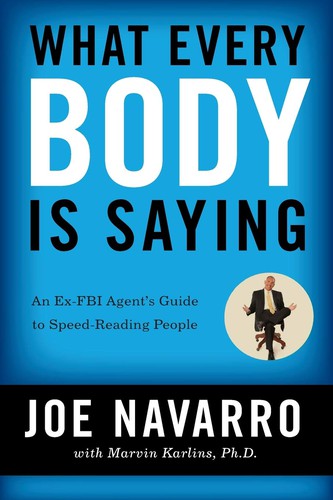
What Every Body Is Saying
by Joe Navarro
A practical field guide to reading nonverbals — useful, but padded and light on rigor.
- Status
- Read · August 2024
- Bought
- August 1, 2024
- For
- Engineers who lead, interview, or negotiate · Anyone who reads people for a living · Curious readers of applied psychology
The one-paragraph verdict
Navarro’s pitch is simple — the limbic system leaks, and feet and torsos lie less than faces. The strongest parts are the real counterintelligence anecdotes and the labelled photos, which turn abstract “tells” into things you actually notice afterward. The weakness is structure: it’s a loosely organized catalogue, repetitive in stretches, and it leans on anecdote where I wanted controlled evidence. It also oversells certainty — reading discomfort is not reading intent, and the book underplays how often context, not a foot angle, is doing the work.
Who should read it
Read it if you interview candidates, run negotiations, or lead people and want a vocabulary for the signals you already half-sense. It pairs well with anyone who lives in meetings. Skip it if you came for peer-reviewed psychology or a deception-detection method you can defend in a room of skeptics — that book this is not.
Where it earned its place
It earned its spot by making me a better observer, not a mind reader. After it, I catch the pacifying gesture in a tense 1:1 or the genuine-versus-polite shift in a stakeholder’s posture — and mostly use it as a cue to ask a better question, not to declare a verdict. That restraint is the actual takeaway.
Skip it if…
Skip it if you treat pop-psych claims as load-bearing, or if anecdote-as-evidence annoys you. Treated as a confidence-rated heuristic rather than a lie detector, it pays for itself. See the [Goodreads page] for the broader split.