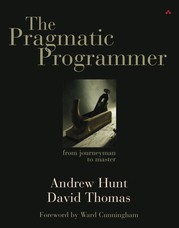
The Pragmatic Programmer
by David Thomas & Andrew Hunt
Still the best single book on the day-to-day habits that separate working code from a working career.
- Status
- Read · January 2022
- Bought
- January 11, 2022
- For
- Working software engineers at any level · Self-taught developers filling craft gaps · Tech leads setting team norms
Where it earned its place
The one-paragraph verdict
A bible and an absolute must-have — there are no excuses for a working engineer not to have read this. Most “be a better programmer” books rot in five years; this one mostly hasn’t, because it talks about decisions instead of syntax. DRY, tracer bullets, orthogonality, “don’t live with broken windows” — these are still the vocabulary I reach for in code review. The recurring praise is fair: it’s a great mix of solid advice and memorable analogies, readable in a weekend. The honest criticism is also fair — by now a lot of it is folklore you’ve half-absorbed by osmosis, the tips can feel like a listicle, and the original edition’s tooling examples are dated. The 20th-anniversary edition patches some of that.
Who should read it
Any working engineer who’s never sat down with it, and any self-taught dev who can ship features but senses gaps in the why. It’s also a clean reference for a tech lead codifying team norms. Skip it if you’re chasing depth on a specific topic — this is breadth, not a deep dive on testing, design, or distributed systems.
Where it earned its place
The “don’t live with broken windows” rule is why my local dev setup front-loads linting, formatting, and a one-command bootstrap — friction is where rot starts. And the chapter on reversible decisions is exactly the reasoning behind switching from UUID to NanoID: pick the identifier that keeps later choices cheap rather than the one that’s merely conventional.
Skip it if…
You’ve been writing software for a decade and already mentor others — you’ll nod along and learn little. And if you wanted a rigorous treatment of one subject, this deliberately isn’t that; it’s a generalist’s checklist, not a specialist’s manual.