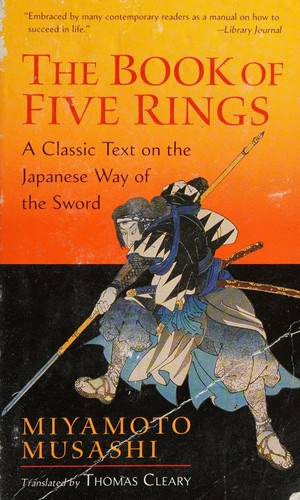
The Book of Five Rings
by Miyamoto Musashi
A 1643 swordsman's notes that double as a strategy primer — if you bring your own examples.
- Status
- Read · June 2026
- Bought
- June 8, 2026
- For
- Engineers who like terse, first-principles strategy texts · Anyone interested in martial-arts philosophy or Zen practice · Readers who don't need a book to spell out the application for them
The one-paragraph verdict
Musashi was an undefeated duelist, and the book reads like a craftsman’s field notes: economy of motion, knowing the terrain, attacking the moment your opponent is committed. The recurring praise is fair — the ideas about timing, posture, and seeing through pretense map cleanly onto any adversarial or competitive endeavor, much like Sun Tzu. The recurring criticism is also fair: it’s terse to the point of vagueness, and Musashi keeps telling you to “research this thoroughly” instead of showing you how. You supply the examples; the book supplies the frame. The Cleary translation’s introduction does real work bridging that gap.
Who should read it
Read it if you like distilled, first-principles texts and you’re comfortable doing the interpretation yourself — the payoff is in the connections you draw, not the ones handed to you. Skip it if you want a structured strategy playbook with worked cases; this is a 17th-century swordsman’s philosophy, not a framework with a table of contents.
Where it earned its place
It gave me a useful mental habit more than any specific tactic: collapse the gap between perceiving and acting, and stop telegraphing intent. The chapter on rhythm — yours and your opponent’s — stuck with me longer than I expected. Mostly, though, it’s here because it’s a good, quiet read that respects your time.
Skip it if…
If you bounce off aphoristic, context-free advice, or you wanted a literal manual for anything other than fighting with two swords, this will frustrate you. It’s a primary source, not a synthesis.
[The Book of Five Rings on Goodreads]