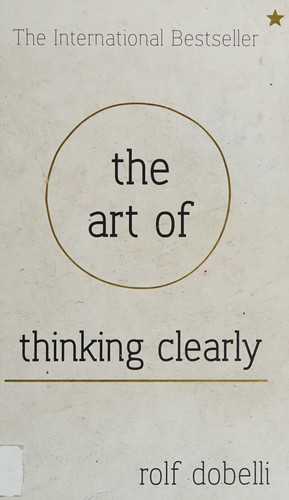
The Art of Thinking Clearly
by Rolf Dobelli
A flashcard deck of cognitive biases — useful as a reference, thin as a book.
- Status
- Read · May 2022
- Bought
- May 31, 2022
- For
- Engineers who make a lot of judgment calls under uncertainty · Anyone reviewing designs, estimates, or postmortems · Readers who want bias names without 400 pages of theory
The one-paragraph verdict
Dobelli takes the cognitive-bias canon — sunk cost, survivorship, confirmation, anchoring — and reduces each to a tight two-page chapter with a memorable example. The format is the whole appeal: it’s skimmable, and the examples stick. It’s also the whole weakness. There’s no central argument, no synthesis, just a list, and most of the material is lifted straight from Kahneman and Taleb, who both did it with more depth. A few chapters contradict each other and a couple of the studies cited have aged badly. As a primer it lands; as a thesis it doesn’t try.
Who should read it
Anyone who makes judgment calls under uncertainty and wants the vocabulary fast — naming a bias mid-meeting is half the battle. Good for engineers in design reviews, estimates, and postmortems. Skip it if you’ve already read Thinking, Fast and Slow; you’ll find nothing new, only shorter.
Where it earned its place
It gave me a working checklist more than an argument. I started catching sunk-cost reasoning in my own “we’ve already built half of it” instincts, and survivorship bias in every “here’s how the winners did it” blog post. The brevity is what made it stick — short enough to reread a chapter before a decision actually goes sideways.
Skip it if…
You want rigor, citations you can chase, or a coherent theory of how the mind misfires. This is the SparkNotes version. Read the originals instead.
[The Art of Thinking Clearly on Goodreads]