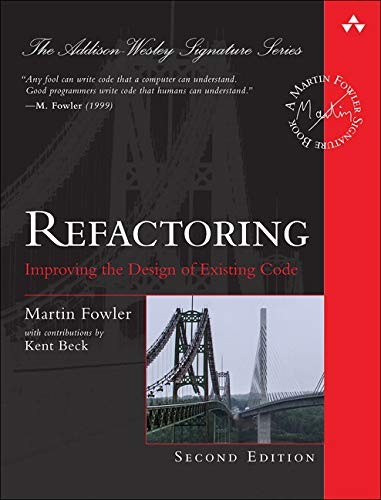
Refactoring
by Martin Fowler
The book that gave a shared vocabulary to changes I was already making by feel.
- Status
- Read · February 2022
- Bought
- February 14, 2022
- For
- Engineers working in large, long-lived codebases · Anyone planning an incremental migration over a rewrite · Tech leads who need shared language for code change
Where it earned its place
The one-paragraph verdict
Great book, but one that requires focus — not an airport read you pick up for the flight. Fowler works through concrete code examples with a discipline that rewards attention; skim it and you’ll miss the point. Most of the refactorings are things a competent engineer already does on instinct, and the common criticism is fair: read cover to cover, the catalog feels obvious and repetitive. That misses the point. Fowler’s contribution is the naming and the discipline — small, behavior-preserving steps backed by tests, each one mechanical enough to describe precisely. The second edition’s switch to JavaScript examples reads cleanly, and the opening worked example is still the best argument for the method. It’s a reference you raid, not a novel you finish.
Who should read it
Read it if you spend your days inside code other people wrote, or if you’re about to argue for incremental change over a rewrite and need the vocabulary to win that argument. Skip it if you’re a beginner still learning to make code work at all — refactoring assumes you already have tests and a working system to improve.
Where it earned its place
The catalog shaped how I framed the strangler-fig migration for archives: the whole approach is just Fowler’s small-steps discipline scaled from functions to services. Each slice we peeled off the legacy path was a behavior-preserving move with a test harness around it — the book’s core idea, applied at architecture altitude.
Skip it if…
You want advanced design theory or novel techniques — this is a disciplined catalog of the basics, not a frontier. If “extract function” is already muscle memory and you don’t lead a team that needs shared language for it, your money goes further elsewhere.