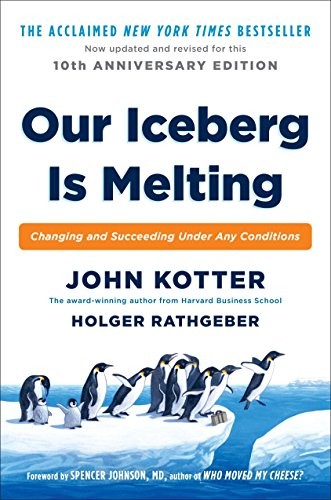
Our Iceberg Is Melting
by John Kotter & Holger Rathgeber
A penguin fable that smuggles Kotter's 8-step change model past your defenses — useful once, thin on reread.
- Status
- Read · April 2025
- Bought
- April 26, 2025
- For
- Engineering leads running their first real change effort · Anyone who has to sell a migration to a skeptical team · Managers who bounced off Kotter's denser Leading Change
Where it earned its place
The one-paragraph verdict
This is Kotter’s change model wearing a penguin costume. A colony’s iceberg is melting, one bird notices, and the story walks through forming a guiding coalition, creating urgency, and locking in the win. The fable framing is the whole trick — it’s why the eight steps actually lodge in memory instead of evaporating like another slide deck. The cost is real, though: critics calling it simplistic and faintly condescending are not wrong. It tells you change needs urgency and a coalition; it tells you almost nothing about how to manufacture either when the people around you are comfortable. Read it as a mnemonic, not a manual.
Who should read it
First-time change leaders, and anyone who has to convince a roomful of Frostbite-the-penguins that the status quo is the actual risk. It’s a 90-minute read, which is its best argument. Skip it if you’ve already internalized Kotter — you’ll find nothing in the fable that the framework didn’t already give you, minus the penguins.
Where it earned its place
The “create urgency before you propose the fix” beat is exactly the move behind Migrations, not rewrites. The hard part of a strangler-fig migration is never the code — it’s getting the org to feel the melting iceberg before the rewrite crowd sells everyone a shiny new continent. This book gave me the vocabulary for that conversation.
Skip it if…
You want tactics, not parable. If you’ve read [Leading Change] or you’re past your first change effort, this adds warmth but no new information — pass.