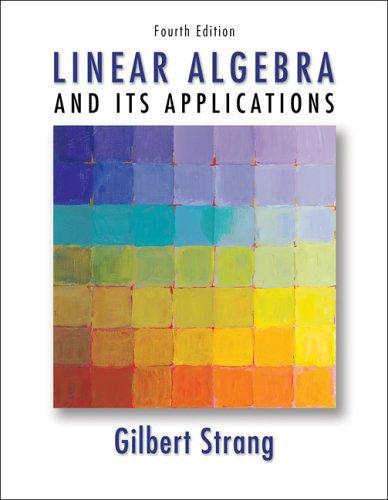
Linear Algebra and Its Applications
by Gilbert Strang
Builds the intuition behind the math you lean on, not a clean reference you keep on the desk.
- Status
- Read · January 2023
- Bought
- January 16, 2023
- For
- Engineers shipping ML or embeddings work · Anyone who wants the why behind matrix decompositions · Self-learners refreshing undergrad linear algebra
Where it earned its place
The one-paragraph verdict
Strang’s whole bet is that you understand linear algebra better by seeing what a matrix does than by grinding through proofs, and that bet mostly pays off — column space, null space, and the geometry of projection finally clicked for me here in a way they never did in undergrad. The cost is real, though: the notation is loose and the prose wanders, so the book is a poor desk reference. When I needed to look something up later, I reached for other sources. The public 4.29 reflects how many people it has helped learn; my 3.5 reflects how little I reach for it after learning. It teaches well and references badly.
Who should read it
Read it if you are an engineer who can do the mechanics but never built the intuition — the geometric framing of SVD and eigendecomposition is the payoff. Skip it if you already think comfortably in subspaces, or if you want a rigorous, lookup-friendly text; Strang is neither.
Where it earned its place
The intuition paid off directly in the embedding pipeline behind the Archives project. Understanding embeddings as vectors in a space — where cosine similarity is just a normalized projection and dimensionality reduction is a change of basis — came straight from Strang’s geometric treatment, not from any vector-database doc.
Skip it if…
You want a reference you keep open while working, or you already reason fluently about bases and projections. Strang is a teacher, not a manual — once the intuition lands, the book goes back on the shelf.