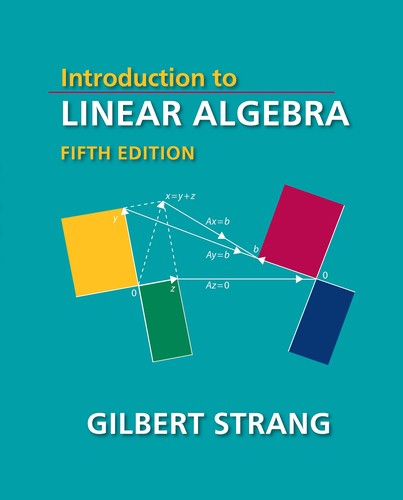
Introduction to Linear Algebra
by Gilbert Strang
The book that made eigenvectors stop feeling like magic — geometry first, proofs second.
- Status
- Read · January 2023
- Bought
- January 16, 2023
- For
- Engineers who reach for vector math but never built intuition for it · ML and embeddings practitioners who want the why under the matmul · Self-taught programmers filling a missing undergrad course
Where it earned its place
The one-paragraph verdict
Most linear algebra texts bury you in determinant cofactor expansions before you understand what a matrix does. Strang inverts that: he leads with the four fundamental subspaces and the geometry of projection, then earns the mechanics. The exposition is genuinely clean — the recurring “Review of the Key Ideas” sections and worked examples are the parts I went back to. The honest criticism, which I share with a chunk of Goodreads, is that it reads less like a self-study book and more like a companion to his MIT lectures: terse where a beginner wants a second pass, and the problem sets lean hard on you having watched him work. Pair it with the video course and that gap closes.
Who should read it
Read it if you use vectors and matrices daily — embeddings, transforms, least-squares — but never built the intuition underneath. It rewards engineers who want to understand why cosine similarity works, not just call it. Skip it if you want a rigorous proof-first treatment for a pure-math track; this is applied and unapologetic about it.
Where it earned its place
The four-subspaces framing and projection geometry are exactly what made the embedding pipeline behind Archives make sense to me. Cosine similarity in a vector store stopped being a black box once I could see it as a dot product over normalized vectors — Strang’s chapters on orthogonality and projection are where that intuition came from.
Skip it if…
You want airtight proofs and abstract vector spaces over arbitrary fields — go to Axler. And if you won’t watch the accompanying lectures, the book alone will feel thinner than its reputation suggests.
[Introduction to Linear Algebra on Goodreads]