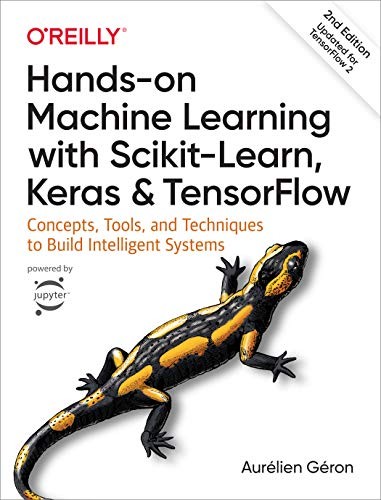
Hands-On Machine Learning with Scikit-Learn, Keras & TensorFlow
by Aurélien Géron
The one ML book I'd hand a backend engineer who needs working models, not a math degree.
- Status
- Read · August 2021
- Bought
- August 27, 2021
- For
- Backend & platform engineers shipping their first ML feature · Engineers who want intuition before theory · Anyone moving from scikit-learn into deep learning
Where it earned its place
The one-paragraph verdict
Géron does the thing most ML books refuse to: he builds intuition first and saves the math for when you actually need it. Part 1 walks scikit-learn end to end — pipelines, cross-validation, the un-glamorous data-prep work nobody else dwells on — and Part 2 takes you into Keras and TensorFlow without pretending it’s easy. Reviewers who waded through twenty ML books keep landing on this one as the best, and I agree. The honest catch: it’s light on theory by design, so if you want proofs you’ll look elsewhere — and the TensorFlow chapters age faster than the rest, because the API keeps moving under them.
Who should read it
Read it if you’re a backend or platform engineer who needs a working model this quarter and wants intuition before notation. The exercises are worth doing, not skimming. Skip it if you’re after a rigorous statistical-learning treatment — this is a builder’s book, not a theorist’s.
Where it earned its place
The pipeline-and-evaluation discipline from Part 1 is exactly what carried over into the NER work behind Archives. Treating models as components you measure, version, and ensemble — rather than oracles — shaped the Ensemble NER (spaCy + LLM) voting setup, and the feature-and-evaluation habits show up directly in the spaCy NER document analysis pipeline.
Skip it if…
You want deep mathematical foundations, or you’re already past the basics and live in production ML — the book’s strength is onboarding, and you’ll outgrow the second half as the frameworks shift.