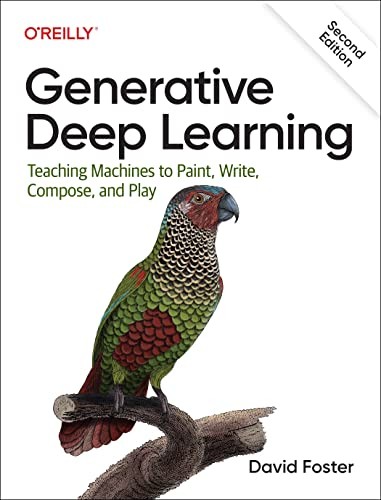
Generative Deep Learning
by David Foster
The clearest hands-on tour of generative models — strong on vision, thinner on text.
- Status
- Read · July 2023
- Bought
- July 2, 2023
- For
- ML engineers building generative models · Backend engineers ramping into deep learning · Anyone wiring up embeddings or autoencoders in practice
Where it earned its place
The one-paragraph verdict
Foster does the rare thing: he makes you implement each generative architecture in Keras until the mechanism clicks, instead of admiring it from a distance. The chapters on autoencoders, GANs, and diffusion are excellent — clear diagrams, runnable code, and just enough theory to know why each piece exists. Where it sags is text: the Transformer and attention material is noticeably thinner than the vision chapters, and a few deep claims get stated without the elaboration they deserve. It’s a builder’s book, not a reference, and it ages with its framework choices — but as a first real contact with generative modeling it’s hard to beat.
Who should read it
ML and backend engineers who learn by typing out the model and watching it train. If you want a rigorous probabilistic treatment or a current survey of frontier LLM internals, look elsewhere — this is a practical on-ramp, not the last word on attention.
Where it earned its place
The latent-space intuition from the autoencoder chapters carried straight into the embedding pipeline behind Archives: thinking of an embedding as a point in a learned, navigable space — not a magic vector — is exactly the framing Foster drills in, and it made the retrieval design far less mysterious.
Skip it if…
You need a math-first or framework-agnostic treatment, or you’re chasing the latest LLM architecture details — the code-bound, Keras-centric approach will feel dated and shallow on text generation.