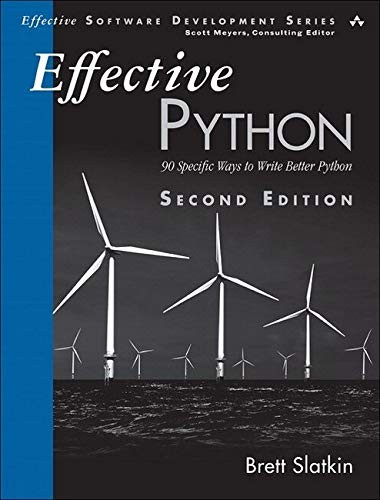
Effective Python
by Brett Slatkin
Was essential reading for idiomatic Python — less so in 2026 as the ecosystem has matured around it.
- Status
- Read · January 2021
- Bought
- January 18, 2021
- For
- Python developers past the beginner stage · Engineers shipping production Python, not scripts · Anyone reviewing other people's Python
Where it earned its place
The one-paragraph verdict
Was relevant, and genuinely useful when I read it — but the gap has narrowed. Slatkin took Scott Meyers’ “Effective C++” item format and applied it to Python, and it works better than it has any right to. Each entry is a few pages: a concrete recommendation, the reasoning, and a worked example you can actually steal. The deep dives into Python’s object model — generators, descriptors, metaclasses, the way __init_subclass__ and the data model fit together — are the real value; this is where idiomatic Python stops being folklore. It is not exhaustive the way
[Fluent Python]
is, and a few early items are basic enough that a seasoned dev will skim them. That trade is fine: I’d rather have 90 sharp opinions I can finish than 800 pages I won’t.
Who should read it
Anyone writing Python past the “it runs” stage, and especially anyone who reviews other people’s Python and wants a shared vocabulary for why a snippet is wrong. Skip it if you’ve never written a class or a comprehension — start with a tutorial first, then come back.
Where it earned its place
The concurrency and generator items shaped the document pipeline behind Archives. The spaCy NER document analysis stage leans on generator-based streaming straight out of the book’s “prefer generators” guidance, and the Ensemble NER (spaCy + LLM) voting layer uses the data-model and dataclass patterns Slatkin argues for instead of ad-hoc dicts. Cleaner diffs, fewer surprises.
Skip it if…
You want a reference manual or an exhaustive deep dive — this is a curated set of opinions, not a complete map of the language. Reach for Fluent Python instead.