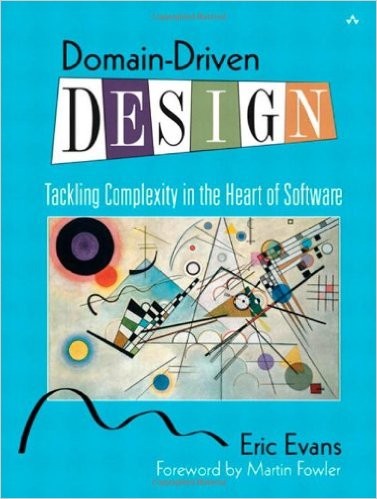
Domain-Driven Design
by Eric Evans
The vocabulary half my architecture arguments now run on — worth the slog.
- Status
- Read · January 2021
- Bought
- January 30, 2021
- For
- Backend & domain modellers · Architects fighting complexity · Anyone naming aggregates badly
Where it earned its place
The one-paragraph verdict
The bible. Dry, occasionally academic, and still the book every serious backend engineer needs to go through — there is no shorter path to the ideas. Evans’ real contribution isn’t the patterns — aggregates, value objects, repositories — it’s the insistence that the language you speak with domain experts becomes the language of the code. Ubiquitous language and bounded contexts reframed how I think about service boundaries, full stop. The criticism reviewers level at it is fair: the prose drifts toward academia, the sentences are long, and several concepts are abstract to the point of being unreadable without the worked examples. You skim the strategic-design chapters once and use them for years. It earns “essential” despite, not because of, how it reads.
Who should read it
Backend engineers and architects wrestling with genuinely complex domains — the kind where the business rules, not the database, are the hard part. If you’re building CRUD over a handful of tables, the overhead isn’t worth it and you’ll resent the abstraction tax. Read it when the model is the problem.
Where it earned its place
The vocabulary runs straight through Archives. Bounded contexts gave the document-processing pipeline clean seams; the end-to-end guide is essentially my field notes from applying it. The hardest call — where one aggregate ends and consistency stops being guaranteed — is the subject of aggregates & consistency boundaries, and the smallest, highest-leverage idea, modelling identity-free concepts as immutable value objects in C#, I now reach for reflexively.
Skip it if…
Your domain is thin, your deadlines are short, or you want a tutorial rather than a treatise — start with a modern DDD distillation instead and come back to [Domain-Driven Design (Goodreads)] when the complexity actually shows up.